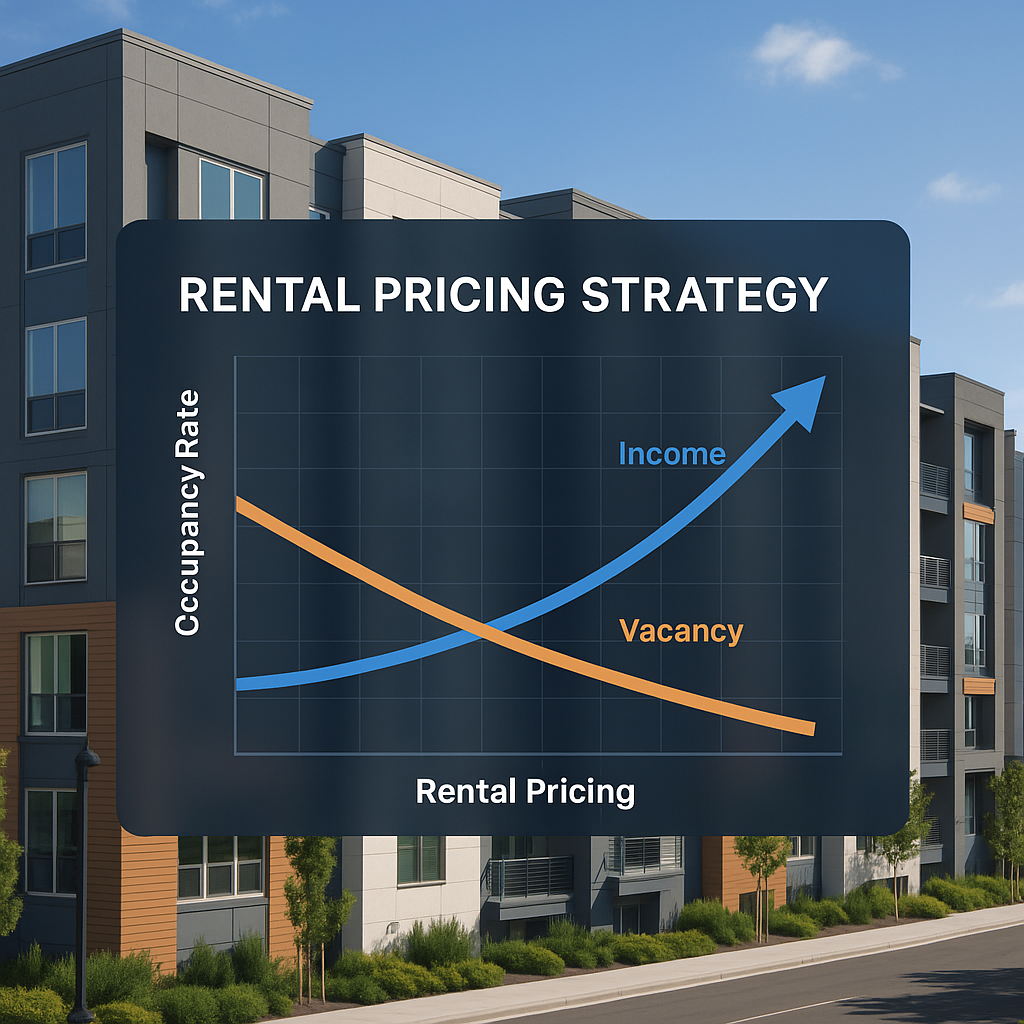
Strategic rental pricing decisions directly influence your property's vacancy rates, tenant retention, and overall investment returns—understanding this relationship is essential for maximizing portfolio performance.
The Direct Correlation Between Pricing Strategy And Vacancy Rates
Rental pricing strategy represents one of the most critical determinants of vacancy rates and overall portfolio performance for Sacramento property investors. The relationship between price point and vacancy is neither arbitrary nor linear—it follows a distinct economic pattern that sophisticated property managers must understand to optimize returns. When rental rates align with market expectations and property value propositions, vacancy rates typically stabilize within acceptable ranges of 3-5%. However, even modest pricing miscalculations can trigger exponential increases in vacancy duration, fundamentally undermining net operating income (NOI) and diminishing annualized returns on investment.
The financial impact of vacancy loss extends beyond simple foregone rental income. Each additional day a unit remains vacant compounds operational costs, including utilities, maintenance, marketing expenses, and opportunity costs associated with capital deployment. For a property generating $2,000 in monthly rent, a 30-day vacancy represents $2,000 in direct income loss, but the true cost—factoring in turnover expenses, marketing, and potential concessions—often exceeds $3,500 to $4,000 per vacancy cycle. This amplification effect underscores why pricing strategy must be treated as a primary driver of investment performance rather than a secondary consideration.
Market data from Sacramento's rental market demonstrates that properties priced within 5% of comparable market rates achieve average vacancy periods of 15-21 days, while properties exceeding market rates by 10% or more experience vacancy durations extending to 45-60 days or longer. This differential translates directly to bottom-line performance: a property maintaining 95% occupancy through strategic pricing will consistently outperform a property achieving 88% occupancy due to overpricing, even if the latter commands nominally higher rents when occupied. Understanding this correlation enables property owners to make data-driven pricing decisions that prioritize occupancy optimization and income stability over speculative rate maximization.
Market-Rate Analysis: Finding The Optimal Price Point For Maximum Occupancy
Effective market-rate analysis requires systematic evaluation of comparable properties, neighborhood dynamics, seasonal demand fluctuations, and property-specific value differentiators. For Sacramento property investors, this process begins with comprehensive comparative market analysis (CMA) that examines recently leased properties with similar characteristics—including square footage, bedroom/bathroom configuration, amenities, condition, and location. However, sophisticated pricing strategy extends beyond simple averaging of comparable rents; it requires understanding the distribution of pricing within the market segment and identifying where your property's unique attributes position it within that spectrum.
The optimal price point for maximum occupancy typically falls within a narrow band—generally the 45th to 55th percentile of comparable properties when ranked by price. Properties positioned at this range capture the broadest segment of qualified tenant prospects while maintaining competitive rental income. Pricing at the 70th percentile or above narrows the prospect pool significantly, extending marketing time and increasing vacancy risk. Conversely, pricing below the 30th percentile may accelerate leasing velocity but often attracts lower-quality applicants and leaves substantial income on the table. The precision required in this analysis underscores the value of professional property management expertise and access to comprehensive market data.
Dynamic market conditions necessitate continuous pricing recalibration rather than static annual adjustments. Sacramento's rental market experiences seasonal fluctuations, with peak demand typically occurring from May through August and softening from November through February. Properties coming available during peak seasons can command premium pricing with minimal vacancy risk, while off-season availability may require strategic pricing concessions to maintain occupancy targets. Additionally, macroeconomic factors—including interest rate environments, employment trends, and housing supply dynamics—create shifting market conditions that demand responsive pricing strategies. Property managers who implement quarterly pricing reviews and maintain real-time market intelligence consistently outperform those relying on annual adjustments or intuition-based pricing decisions.
How Overpricing Drives Extended Vacancy Loss And Reduces Annual Returns
Overpricing represents one of the most consequential errors in property management, creating a cascade of negative financial outcomes that compound over time. When rental rates exceed market-supported levels by 8-10% or more, properties experience dramatically extended vacancy periods that erode annual returns far more severely than the incremental income gained during occupied periods. Consider a property with a market-supported rent of $2,000 monthly: overpricing at $2,200 might generate an additional $2,400 annually if fully occupied, but if overpricing extends vacancy from 15 days to 45 days, the property loses $2,000 in immediate income—effectively negating any benefit from the higher rate while incurring additional marketing and turnover costs.
The mathematical reality of vacancy loss becomes particularly stark when analyzed on an annualized basis. A property achieving 92% occupancy at $2,200 monthly generates $24,288 in annual income, while the same property achieving 97% occupancy at $2,000 monthly generates $23,280—a difference of only $1,008 annually. However, this analysis fails to account for the additional costs associated with extended vacancy: increased marketing expenses, higher turnover frequency (as tenants priced into properties above market value demonstrate lower retention rates), and the compounding effect of multiple vacancy cycles. When these factors are incorporated, the overpriced property frequently underperforms by $2,000-$3,000 annually despite commanding nominally higher rents.
Extended vacancy periods also introduce qualitative risks that impact long-term portfolio performance. Vacant properties require more intensive oversight, face elevated security and maintenance risks, and may experience neighborhood perception challenges if vacancies become prolonged or frequent. Additionally, overpricing often necessitates eventual price reductions, which can create negative market signaling—prospective tenants may perceive price-reduced properties as problematic or overvalued, further extending vacancy duration. Professional property managers recognize that optimal pricing strategy prioritizes consistent occupancy and income stability over speculative rate maximization, understanding that reliable cash flow and tenant retention drive superior risk-adjusted returns over complete investment cycles.
Strategic Underpricing: When Lower Rent Increases Net Operating Income
Strategic underpricing—positioning rental rates slightly below market median—represents a sophisticated approach to portfolio optimization that can paradoxically increase net operating income despite lower nominal rents. This strategy proves particularly effective in competitive markets, during tenant retention initiatives, or when property owners prioritize occupancy stability and reduced turnover costs. By pricing 3-5% below market median, property managers create compelling value propositions that accelerate leasing velocity, expand the qualified prospect pool, and improve tenant quality through competitive selection processes.
The financial mechanics of strategic underpricing become evident when analyzing total occupancy costs and turnover frequency. A property rented at $1,900 monthly (5% below a $2,000 market median) sacrifices $1,200 in annual rental income if fully occupied. However, if this pricing strategy reduces average vacancy from 20 days to 10 days per turnover cycle and extends average tenancy duration from 18 months to 24 months, the property experiences fewer turnover events and lower aggregate vacancy loss. With typical turnover costs ranging from $3,500-$4,000 per cycle (including vacancy loss, marketing, maintenance, and administrative expenses), reducing turnover frequency from every 18 months to every 24 months generates savings of approximately $1,750 annually—substantially offsetting the $1,200 in foregone rent while improving cash flow predictability.
Strategic underpricing also enhances tenant quality and retention rates by creating positive value perception. Tenants who recognize they are receiving above-market value demonstrate higher satisfaction levels, greater property care, more consistent rent payment performance, and extended tenancy duration. This dynamic creates a virtuous cycle: superior tenants reduce maintenance costs, minimize lease violations, and require less intensive management oversight, further improving net operating income. For Sacramento property investors managing multiple units or portfolios, strategic underpricing on select properties can optimize overall performance by ensuring consistent occupancy, reducing management intensity, and creating capacity to focus resources on higher-value activities such as proactive maintenance and portfolio expansion strategies.
Data-Driven Pricing Adjustments To Minimize Turnover And Maximize Tenant Retention
Data-driven pricing adjustments represent the intersection of market intelligence, tenant behavior analysis, and proactive retention strategy. Rather than implementing uniform annual rent increases based on arbitrary percentages or inflation indices, sophisticated property managers utilize comprehensive data analysis to determine optimal renewal pricing that balances income growth with retention probability. This approach requires systematic tracking of renewal acceptance rates at various increase thresholds, competitive market monitoring, tenant payment history analysis, and property-specific performance metrics that inform individualized pricing decisions.
Research consistently demonstrates that renewal rent increases exceeding 5-7% annually trigger significantly elevated turnover rates, particularly among high-quality, long-term tenants who represent the most valuable segment of any rental portfolio. When tenants perceive renewal increases as excessive relative to market conditions or their tenancy history, they initiate apartment searches and frequently relocate—even when the increased rent remains market-competitive. The cost of this turnover is substantial: replacing a quality tenant typically costs 75-100% of one month's rent when accounting for vacancy loss, marketing, screening, maintenance, and administrative expenses. For a $2,000 monthly rental, aggressive renewal pricing that triggers turnover costs $1,500-$2,000 per incident, often negating multiple years of incremental rent increases.
Implementing data-driven retention pricing requires establishing clear decision frameworks based on tenant quality metrics, market conditions, and property-specific objectives. High-performing tenants—characterized by consistent on-time payments, minimal maintenance requests, lease compliance, and extended tenancy—warrant preferential renewal pricing, often in the 2-4% increase range, to maximize retention probability. Average-performing tenants may receive market-rate increases of 4-6%, while problematic tenants might receive increases at or above market rates to either improve unit economics or facilitate natural turnover. This segmented approach, supported by comprehensive data analysis and market intelligence, enables property managers to optimize portfolio performance by retaining valuable tenants, improving average tenant quality over time, and ensuring rental income growth remains sustainable without triggering counterproductive turnover cycles. For Sacramento property investors, partnering with professional management firms that maintain robust market data systems and implement sophisticated pricing analytics represents a competitive advantage that directly translates to superior risk-adjusted returns and portfolio stability.
This content is for informational and educational purposes only. It does not constitute an offer or solicitation to buy or sell any security or investment product. Past performance and market trends do not guarantee future results. Consult a licensed financial advisor before making investment decisions. All Inclusive Realty Group, Inc. DRE #02005619.